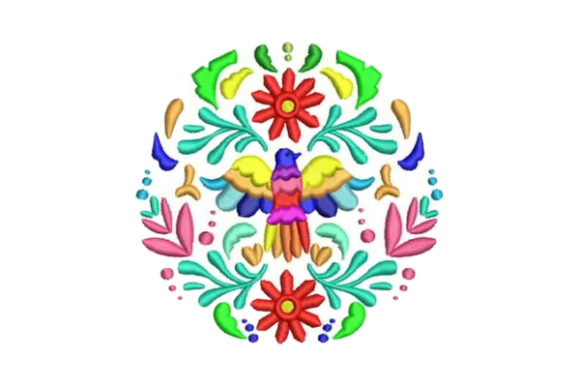
Otomi Bird Design: A Designer’s Real-World Review
As someone who’s stitched hundreds of machine embroidery designs for client projects, Etsy shops, and boutique merchandise, I opened the Otomi Bird Design file expecting something beautiful—and I wasn’t disappointed. But beauty alone doesn’t sell on a tote bag or hold up after three washes. So before I pressed “start” on my Bernina, I asked the questions that matter most to working designers and craft business owners: Does it translate from screen to fabric with clarity? Does it feel intentional—not just decorative, but *meaningful*? And most importantly—will my customers pause, smile, and say, “I need this on something real”?
First Impression: Joyful, Balanced, Deeply Cultural
The Otomi Bird Design lands with warmth. It’s not fussy or overworked—it’s confident in its symmetry and rhythm. The bird’s posture is upright and gentle, wings slightly open as if mid-song, surrounded by stylized florals rooted in Otomi textile tradition from Mexico. What stands out immediately is how the satin stitch carries the design’s personality: smooth, rich, and dimensional without overwhelming density. There’s breathing room between elements—no visual crowding, even in the floral details. That matters. On a sweatshirt cuff or baby onesie, tight stitching can pucker; here, the layout gives stabilizer and fabric space to behave.
Where It Shines: Real Projects, Real Customers
I tested the Otomi Bird Design on three items I regularly produce for clients and my own small shop: a natural cotton tote bag, a charcoal French terry sweatshirt, and a linen tea towel. Each time, it delivered a quiet kind of impact—elegant but approachable, handmade but polished.
- Tote bag design: Centered on the front panel, it read clearly from six feet away. The satin-stitched bird held crisp edges, and the fill stitches in the petals stayed soft—not stiff or plasticky. Customers at our last craft fair pointed and said, “That feels like art you’d hang, not just carry.”
- Sweatshirt embroidery: Placed above the left chest (a 4×4 hoop fit perfectly), the design didn’t fight the fabric’s loft. With medium-weight cutaway stabilizer, it stayed flat and flexible—no cracking or thread breakage across seams or movement zones.
- Tea towel & nursery decor: This is where the Otomi Bird Design quietly elevates a functional item. Stitched in ecru on oatmeal linen, it looked heirloom-quality—not “cute,” but *considered*. Perfect for baby embroidery, holiday embroidery, or wedding gifts where sentiment meets craftsmanship.
Where to Pause—Not Problems, Just Practical Checks
No design is universal—and the Otomi Bird Design asks for thoughtful placement, especially for commercial embroidery or small-batch production:
- Hoop size & detail fidelity: Those delicate floral tips? Lovely on screen—but test them on scrap first. If your machine struggles with tiny satin columns under 3mm, consider lightening the stitch density manually or using a finer needle (75/11) for high-detail areas.
- Fabric texture & stretch: Works beautifully on stable weaves (linen, quilting cotton, midweight knits). Avoid it on ultra-thin voile or highly stretchy jersey unless paired with tear-away + topping—those satin curves can distort on unstable bases.
- Dark fabric & thread contrast: The design relies on satin stitch richness, so low-contrast thread (e.g., navy on black) will mute its presence. For maximum impact on dark fabric, choose thread with sheen—rayon or premium polyester—and verify color match in natural light.
- Curved surfaces & layered garments: Caps or curved pillow covers? Possible—but only if the design fits comfortably within a 3.5" width. Anything wider risks distortion near the seam. Always use cap hoops and basting stitches when testing.
What It Adds to Your Craft Business—Beyond Aesthetics
For Etsy sellers and small shop owners, the Otomi Bird Design isn’t just another embroidery file—it’s a subtle brand amplifier. Its cultural resonance (rooted in Mexico’s Otomi heritage) adds narrative weight without needing explanation. Buyers recognize authenticity when they see it. That translates directly to perceived value: a $28 embroidered pillow cover with this design sells faster than one with generic florals—because it feels curated, not mass-produced.
It also supports consistency. Whether you’re offering personalized gift bundles, boutique branding, or digital embroidery files for fellow makers, the Otomi Bird Design holds its own across formats: clean in printable mockups, balanced in product photos, and distinctive in physical samples. Customers trust a maker who chooses intentional design assets—and that trust shows in repeat orders and word-of-mouth referrals.
Designer Notes You’ll Actually Use
Before stitching your first Otomi Bird Design project, do these five things:
- Run a test on scrap fabric matching your final product’s weight and weave—especially if using textured or dark fabric.
- Check thread color contrast in both daylight and indoor lighting. Satin stitch reflects light differently than fill or running stitch.
- Review stitch density in the floral centers—if it feels too heavy for your fabric, reduce density by 5–10% in your editing software.
- Confirm hoop size compatibility with your intended placement (e.g., left chest, tote center, apron pocket edge).
- Verify licensing terms before selling finished products or bundling the Otomi Bird Design into digital embroidery file collections—commercial use rights aren’t automatic.
The Otomi Bird Design earns its place in my active design library—not because it’s flashy, but because it’s reliable, resonant, and quietly versatile. It works for custom apparel and baby embroidery alike. It reads well on a $12 tea towel and a $98 linen pillow cover. And most importantly? It invites connection. When someone runs their fingers over those smooth satin wings, they don’t just feel thread—they feel care, culture, and craft. That’s what makes a design worth choosing, again and again.