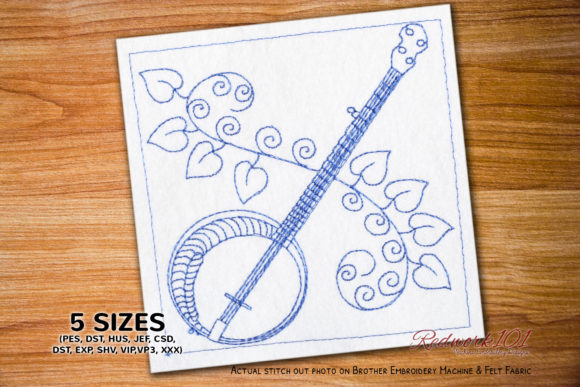
Banjo String Instrument Embroidery Design
First Impression: Charming, Nostalgic, and Market-Ready
As an embroidery designer who’s curated over 200 craft fair booths—from Asheville to Austin—I instantly recognize what makes Banjo String Instrument stand out: it’s warm, approachable, and unapologetically musical. The description—“a stylishly decorated banjo with a floral background”—suggests a thoughtful blend of folk charm and botanical softness. It reads as rustic-elegant rather than cartoonish or overly technical. That’s gold for handmade markets, where shoppers respond to authenticity and story—not just subject matter. It doesn’t scream “joke item” or “niche collector piece.” Instead, it invites connection: the bluegrass fan, the garden-loving musician, the teacher who plays at school assemblies, the Etsy seller building a cohesive “music + nature” shop theme.
Where Banjo String Instrument Shines on Craft Fair Products
This design thrives where personality meets utility. On a heavyweight cotton tote bag? Perfect—its balanced composition (banjo as focal point, floral background as gentle frame) reads clearly from three feet away. As apron embroidery? Ideal for the artisan coffee roaster or bakery owner who wants subtle brand flair without loud logos. For tea towel embroidery? Proceed with caution: the floral background may blur on highly textured terry or looped linen unless stitch density is carefully managed—but on smooth, medium-weight cotton towels, it adds heirloom-level charm.
As an embroidered patch? Highly recommended. The optional Box Stitch (if clean and well-digitized) gives crisp definition and makes it easy to iron-on or sew by hand—ideal for festival-goers customizing denim jackets or backpacks. On caps? Best placed front-and-center on structured, medium-crown cotton twill—avoid curved visors unless the design has been tested for distortion. Small fabric pouches and pillow covers are also strong fits: the scale translates beautifully, and the motif feels giftable, not generic.
Visual Impact & Booth Performance
In a crowded craft fair aisle, Banjo String Instrument earns attention through contrast—not loudness. Its strength lies in quiet confidence: the banjo anchors the eye; the floral background adds depth without competing. Unlike minimalist monograms or abstract motifs, this design tells a micro-story that sparks conversation (“Is that your instrument?” “Do you play?”). That engagement directly lifts booth dwell time—and sales.
It elevates perceived value effortlessly. A plain canvas market bag becomes a handmade product with intention when stitched with Banjo String Instrument. Likewise, a simple tea towel transforms into a small shop product with narrative weight—especially alongside other music-themed embroidery files like sheet music snippets or vintage microphone silhouettes.
Production Practicality: What Works (and What Needs Testing)
From a digitizing and stitching standpoint, Banjo String Instrument appears scalable and batch-friendly—if the floral background isn’t over-stitched. Dense fill areas in petals or stems can cause thread buildup or puckering on lightweight fabrics. Always test the embroidery file on scrap fabric matching your final product: cotton duck for totes, terry for towels, twill for caps. Pay close attention to:
- Stitch density in floral zones—high density risks stiffness on apparel;
- Thread colors against dark fabric—light florals may vanish without underlay or color adjustment;
- Hoop size compatibility—ensure the full design fits comfortably in your most-used hoop;
- Stabilizer choice—cutaway for stretchy knits, tear-away for stable wovens, and fusible + tear-away combo for textured towels.
The “optional Box Stitch” mentioned in the description is a smart touch—it offers versatility. Use it for patches or framed wall hangings; omit it for softer, flowing applications like pillow covers. Just verify whether the box is part of the main embroidery file or a separate layer—this affects editing flexibility for digital sellers.
Careful-Use Notes for Real-World Production
Avoid using Banjo String Instrument at under 3 inches wide on curved surfaces (like cap fronts) without re-digitizing for shape retention. Tiny details—banjo fret markers, stem tendrils—may disappear on coarse fabric or at small scales. If offering printable mockups for Etsy listings, generate high-res renders at multiple sizes (2”, 4”, 6”) to show how clarity holds up. Never assume clarity carries across substrates: a design sharp on smooth satin may soften dramatically on burlap or quilted cotton.
Design Integrity & Brand Alignment
This isn’t a one-off novelty—it supports long-term brand consistency. Pair it with complementary machine embroidery designs in the Music category (e.g., fiddle outlines, vintage record players) and cross-pollinate with Embroidery-friendly botanicals (lavender sprigs, climbing roses) to build a recognizable aesthetic. For boutique makers, that cohesion turns casual browsers into repeat buyers.
It also reinforces handmade quality. Because the banjo is stylized—not photorealistic—it avoids looking mass-produced. Customers sense care in the line work, balance, and intentional negative space. That perception justifies premium pricing and strengthens buyer trust—critical for Etsy sellers and small shop product lines.
Final Designer Checklist Before Booth Day
Before cutting fabric or loading hoops, run through these must-do steps:
- Test the embroidery file on scrap fabric matching your final product;
- Check thread contrast—especially on dark or heathered textiles;
- Review spacing between banjo and floral elements—tight gaps may merge in stitching;
- Confirm hoop size requirements and adjust placement for each product type;
- Inspect stitch density in floral zones—reduce if needed for drape and comfort;
- Select stabilizer based on fabric texture and end use (e.g., cutaway for aprons worn daily);
- Create at least one real mockup—not just a digital preview—to assess true color harmony and scale;
- Compare thread colors across multiple fabric swatches (natural light + booth lighting);
- Verify commercial licensing terms—this is essential for selling finished products, not just digital embroidery files.
Banjo String Instrument isn’t just another music-themed embroidery file. It’s a conversation starter, a versatile design asset, and a quietly confident craft fair product waiting to find its people. When executed with attention to fabric, thread, and context, it doesn’t just decorate—it resonates.