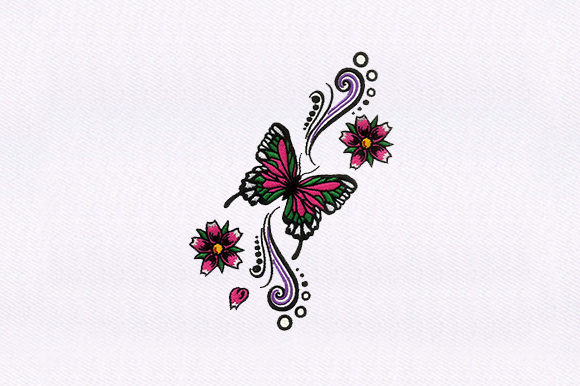
Floral Butterfly: A Smart Embroidery Choice for Small Business Branding
First Impression: Friendly, Fresh, and Professionally Approachable
As an embroidery designer who’s developed hundreds of commercial designs for small businesses—from neighborhood bakeries to indie florists—I immediately recognize Floral Butterfly as a design that balances charm with clarity. The name alone signals softness and natural appeal—ideal for brands leaning into handmade, eco-conscious, or artisanal positioning. It doesn’t scream “bug” in a literal, taxonomic sense (which is good), but rather evokes lightness, transformation, and botanical warmth. That makes it far more versatile than many entries in the Bugs category. It feels modern enough for a creative studio’s tote bag, elegant enough for a boutique apron, and playful enough for a pet brand’s staff cap—without tipping into cutesy overkill.
Real-World Performance Across Merchandise Types
In practice, Floral Butterfly shines where small business merch needs personality *and* polish. As an embroidered patch, it holds its shape beautifully on denim jackets, canvas totes, and woven labels—especially when backed with high-quality twill or chenille. For custom apparel, it works exceptionally well as a chest logo on staff uniforms: not so large it overwhelms, not so delicate it fades into the background. On aprons? Perfect. Its organic flow complements the curved drape of fabric while maintaining legibility at 3–4 inches wide.
Floral Butterfly also transitions smoothly to cap embroidery. Unlike dense geometric motifs, its open negative space and gentle curves adapt well to the front curve of structured caps—no distortion or puckering if digitized thoughtfully. For tote bag design, it adds instant character without competing with printed text or logos. And on product packaging accents—think stitched tags on handmade soap boxes or linen pouches—it elevates perceived value, subtly reinforcing a brand’s commitment to craft.
Where to Use Floral Butterfly Thoughtfully
Like any strong machine embroidery design, Floral Butterfly demands thoughtful placement. Avoid scaling it below 1.75 inches for patches—fine wing details and floral filigree may collapse or stitch poorly on textured fabric like heavy canvas or terry cloth. On dark uniforms, confirm thread color contrast: pale pastels won’t read clearly without a white underlay or careful stabilizer selection. Also, test it on curved surfaces (like cap fronts or sleeve cuffs) before bulk production—some butterfly wings or stem lines can stretch or compress unexpectedly.
High stitch density isn’t advertised in the description, but floral motifs often carry tighter fills. If your shop uses budget-friendly stabilizers or stitches on lightweight knits, run a sample first. Frequent washing—common for café aprons or bakery uniforms—means tight satin stitches must be balanced with secure underlay and clean jump stitches. When used as a product label on sewn goods, ensure the design’s outer edge allows room for seam allowances and trimming.
How Floral Butterfly Strengthens Brand Identity
This isn’t just decoration—it’s strategic brand identity work. A well-executed Floral Butterfly tells customers your business values care, detail, and authenticity. It signals handmade intention without looking amateurish. For Etsy sellers and crafters, it builds trust: buyers associate precise, balanced embroidery with quality craftsmanship. In retail settings—a local florist’s gift wrap, a boutique’s reusable bag—the design becomes a quiet ambassador, reinforcing visual consistency across touchpoints.
Importantly, Floral Butterfly avoids visual fatigue. It’s distinctive but not overwhelming—ideal for repeat exposure on staff uniforms or daily-use items. Unlike generic icons, it invites curiosity (“Is that a real species? A custom motif?”), which boosts engagement. And because it straddles nature and artistry, it fits seamlessly alongside other design assets: watercolor logos, serif typography, or hand-drawn patterns—making it a flexible anchor in a broader visual system.
Practical Designer Notes Before You Stitch
Before committing to production, follow these proven steps:
- Test the digital embroidery file in black and white first—this reveals balance, spacing, and potential density issues faster than color.
- Check how Floral Butterfly renders at your smallest intended hoop size. Does the stem stay crisp? Do petals retain separation?
- Review thread colors against your fabric swatches—not just on screen. A lavender thread may look soft on white cotton but vanish on heather grey.
- Inspect spacing between elements: tight gaps between wings and flowers can cause nesting or thread breaks on low-tension machines.
- Always test on your actual fabric with the correct stabilizer. Lightweight tear-away works for smooth cotton; cut-away or mesh is safer for knits or textured weaves.
- Create a printable mockup for client approval—show it on a real cap, tote, or apron image, not just a blank hoop.
- Compare Floral Butterfly beside your existing design assets. Does it harmonize with your logo’s weight and rhythm? Does it scale consistently across sizes?
- Confirm commercial licensing explicitly. Since this is intended for small business merch and commercial embroidery, verify usage rights cover resale, branding, and unlimited units.
Remember: even the most charming embroidery file falls short without intentional execution. Floral Butterfly isn’t a “drop-in-and-stitch” solution—it’s a collaborative tool. When paired with smart digitizing, fabric-aware testing, and brand-aligned placement, it transforms everyday items into memorable brand moments. Whether you’re stitching for a flower shop’s summer launch or a maker’s limited-edition line, Floral Butterfly delivers both aesthetic appeal and functional reliability—exactly what small businesses need from their Embroidery investments.